
Why Your Knee Gives Way and How to Stop It
Overview: Why Your Knee Gives Way
Have you ever wondered why your knee gives way, leaving you unstable or even worried about falling? That sudden, unnerving feeling—your knee buckling beneath you—can be both frightening and disruptive to daily life. When your knee gives way, it’s often a sign of a deeper problem with the structures that support and move your joint. This instability, most commonly referred to as knee buckling, is not only uncomfortable—it can also signal underlying muscle weakness, coordination problems, or issues that may increase your risk of further injury.
Understanding exactly why your knee gives way is the crucial first step to overcoming this problem. By identifying the specific causes of knee buckling, you can take targeted steps to regain strength, confidence, and control.
Understanding why your knee gives way is key to tackling the problem head-on. Knees may buckle for a range of reasons, but one of the most frequent causes is muscle weakness—especially after an injury or due to certain health conditions. When the muscles that support the knee, particularly the VMO (Vastus Medialis Oblique), become weak or don’t function correctly, the knee can suddenly give way or buckle. This often results in that jarring sensation of your knee giving way beneath you, which can make walking and daily activities feel unpredictable and unsafe.
Knee buckling is more than just an annoyance; it signals that the joint isn’t receiving enough stability and control, putting you at risk of falls and further injury. In most cases, this momentary instability is rooted in weakness or poor activation of the key muscles responsible for holding the knee in place—especially during movement. Throughout this guide, you’ll learn not only the main reasons why knees might give way but also how you can address the weakness at its source and regain your confidence with every step.
What Causes a Knee to Buckle?
When your knee gives way, it’s a sign that something is disrupting the joint’s stability and that your body is unable to keep your leg steady under load. Knee buckling refers to the sudden loss of knee support that causes your leg to fold unexpectedly, which can leave you feeling unsteady, anxious about movement, and even at risk of falling. There are several reasons why your knee might give way:
- Injury to the ligaments or meniscus: Tears to these crucial structures can compromise the knee’s ability to lock and support your body weight, increasing the chance of buckling.
- Arthritis or joint degeneration: Conditions that wear away the cartilage or irritate the joint lining can interfere with how the knee moves, resulting in unpredictable episodes of instability.
- Muscular weakness, especially in the quadriceps and VMO: Weak or deconditioned muscles can fail to provide proper support, particularly during activities like walking, climbing stairs, or standing from a seated position.
- Nerve or coordination issues: Neurological conditions or problems with your body’s sense of joint position (proprioception) can delay the right muscles from firing at the right time, causing sudden loss of support.
- Functional issues after injury or surgery: Swelling, pain, or periods of reduced activity can “switch off” muscles, especially the VMO, making the knee more vulnerable to giving way in everyday situations.
The implications of knee buckling go beyond just discomfort—it signals that your knee can’t reliably support you and can dramatically increase your risk of trips or falls, further injuries, and a loss of confidence in your movement. Addressing why your knee gives way is critical because it allows you to focus on fixing the root issue, rather than simply reacting to the symptoms.
- Ligament tears
- Arthritis
- Muscular weakness and poor coordination
- Conditions like patellofemoral pain syndrome
However, one of the most common causes is weakness in the quadriceps muscle group at the front of your thigh.
After a knee injury, such as a sprain, meniscus tear, or even surgery, it’s natural to experience pain and swelling. This often leads to a period of reduced activity. During this time, the muscles supporting the knee can weaken significantly. Even without a specific injury, general deconditioning can lead to the same outcome. The result is a knee that lacks the dynamic support it needs to handle everyday movements, making it prone to buckling.
Meet the VMO: Your Knee’s Personal Stabilizer
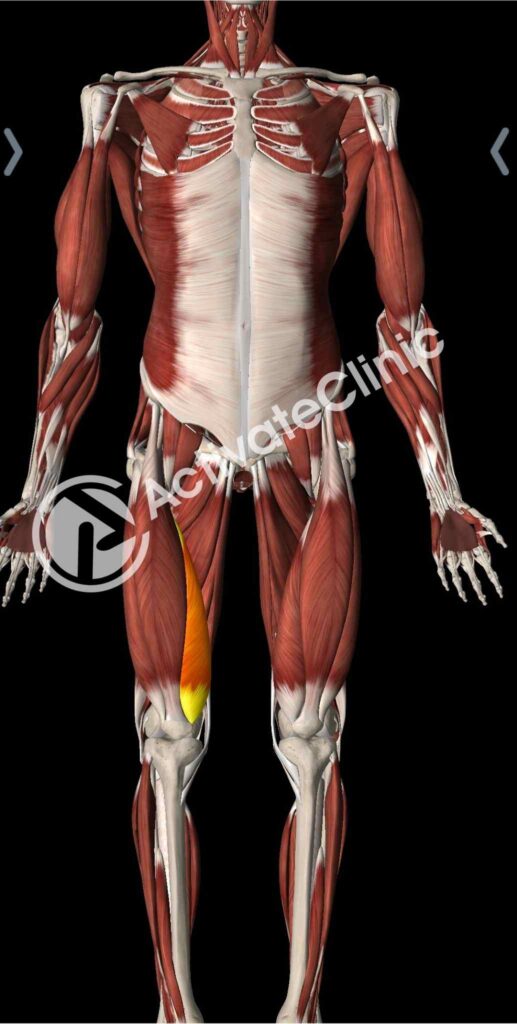
The quadriceps muscle group is a group of four muscles on the front of the thigh. One of these four plays an essential role in knee stability: the Vastus Medialis Oblique, or VMO. This muscle is located on the inner side of your thigh, just above the kneecap. Its primary job is to control the final stage of straightening your leg.
The VMO is responsible for the last 30 degrees of knee extension—that final push to get your leg completely straight. It’s also critical for managing the very beginning of knee flexion, or bending, from a straight position. When you are walking, this controlled movement is what allows your knee to absorb shock and transition smoothly from one step to the next.
How a Weak VMO Leads to Knee Buckling
When the VMO is weak or doesn’t activate at the right time, it fails to properly manage that initial phase of knee bending. Instead of a controlled, gradual bend as you put weight on your leg, the knee can suddenly give way. This rapid, uncontrolled change in the joint’s angle creates that startling buckling sensation and significantly increases your risk of falling.
This “inhibition” of the VMO refers to the muscle’s reduced ability to contract properly and is common after knee injuries. Pain and swelling can send signals to the nervous system that effectively “switch off” the muscle to protect the joint. While this is a helpful short-term defense mechanism, it can become a long-term problem if the muscle isn’t retrained to fire correctly. Without a strong, responsive VMO, the kneecap may not track properly, and the entire joint structure is left vulnerable during dynamic activities.
Building a Stronger, More Stable Knee
The encouraging news is that you can stop your knee from giving way. The solution lies in a targeted approach to strengthen the VMO and retrain its activation patterns. It’s not just about building brute strength; it’s about improving the muscle’s endurance and, most importantly, its control. The goal is to ensure the VMO fires at the right time, with the right amount of force, during every step you take.
Knee buckling can be resolved through three key phases:
- Reactivating the VMO muscle
- Building strength and endurance
- Training functional movement patterns
A comprehensive rehabilitation program focuses on several key areas:
1. VMO Strengthening Exercises
These exercises are designed to isolate and activate the VMO. They often start with simple, non-weight-bearing movements to re-establish the connection between your brain and the muscle. As you progress, the exercises become more challenging and functional.
Examples include:
- Terminal Knee Extensions: Focusing on straightening the leg against resistance for the final few degrees
- Wall Sits with Ball Squeeze: Holding a squat position against a wall while squeezing a ball between your knees to engage the inner thigh muscles, including the VMO
- Step-Ups and Step-Downs: Performing slow, controlled steps onto a small platform, focusing on keeping the knee aligned over the foot
2. Enhancing Endurance and Control
Once the VMO is activating properly, the focus shifts to building its endurance. Your knee needs to be stable not just for one step, but for thousands of steps throughout the day. Endurance exercises involve performing movements for longer durations or a higher number of repetitions to train the muscle to resist fatigue.
Control, or proprioception, is your body’s awareness of its position in space. Exercises that challenge your balance and coordination—like standing on one leg or using unstable surfaces—help fine-tune the VMO’s responsiveness, teaching it to make instant adjustments to maintain stability.
3. Functional Movement Training
The ultimate goal is to integrate this newfound strength and control into your daily activities. Functional training mimics the movements you perform in real life, like walking, climbing stairs, or squatting to pick something up. This ensures that the VMO doesn’t just work in the controlled environment of a clinic but provides reliable support during the unpredictable demands of your day. This could involve analyzing and correcting your walking pattern (gait) to ensure the VMO is engaged with every step.
The Importance of Professional Guidance
While it may be tempting to search for exercises online, addressing knee buckling requires a precise and personalized plan. A qualified Exercise Physiologist or rehabilitation specialist can provide the expert guidance necessary for a safe and effective recovery.
A professional will:
- Accurately Diagnose the Cause: They will perform a thorough assessment to confirm that VMO weakness is the primary issue and rule out other structural problems
- Create a Tailored Program: Your exercise plan will be based on your specific level of strength, control, and personal goals. It will progress at a pace that is right for you, minimizing the risk of re-injury
- Ensure Proper Form: Performing exercises incorrectly can be ineffective or even harmful. A therapist will teach you the correct technique to ensure you are targeting the VMO and not compensating with other muscles
- Adapt the Program as You Improve: As your strength and control increase, your program will be adjusted to continue challenging you and helping you reach your goals
Don’t let the fear of your knee giving way hold you back. By understanding the critical role of the VMO and committing to a targeted exercise program, you can rebuild your knee’s stability from the inside out. Take the first step toward a more confident and active life by seeking professional help to get your knee strong, stable, and reliable once again.
-
Why Your Knee Gives Way and How to Stop It
Overview: Why Your Knee Gives Way Have you ever wondered why your knee gives way, leaving you unstable or even worried about falling? That sudden, unnerving feeling—your knee buckling beneath you—can be both frightening and disruptive to daily life. When your knee gives way, it’s often a sign of a deeper problem with the structures…


No Comments